 KH
KH  FR
FR  AR
AR CN
CNNo Single Nation Can Fight Fake News Alone, Says Information Minister
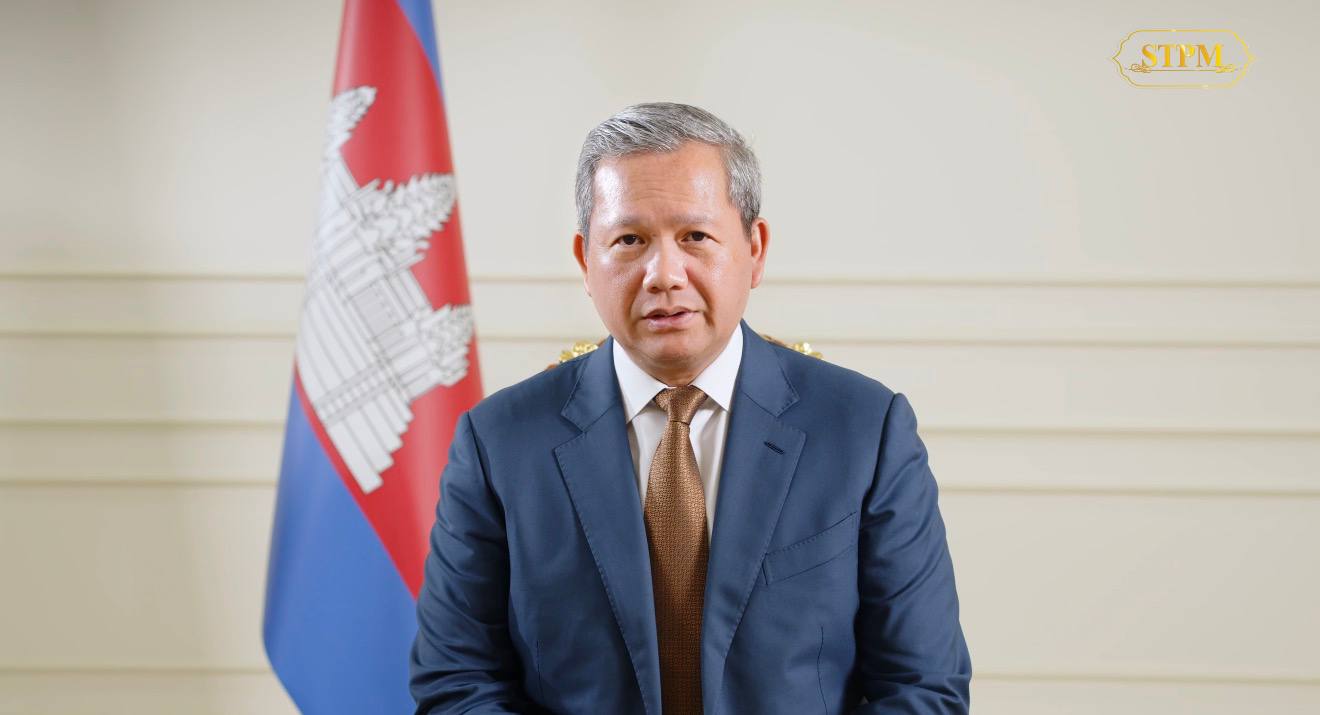
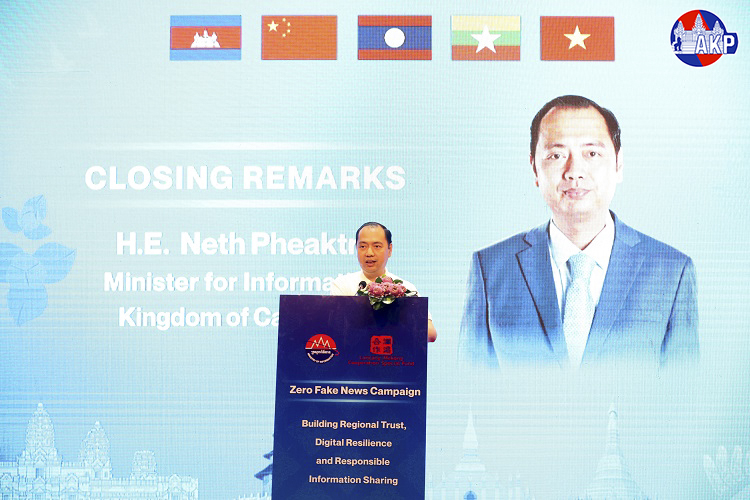
AKP Phnom Penh June 02, 2026 -- Fake news has become a shared regional challenge that requires collective action, as no single country, institution, media organisation, digital platform, or community can tackle the issue alone, according to Cambodian Minister of Information H.E. Neth Pheaktra.
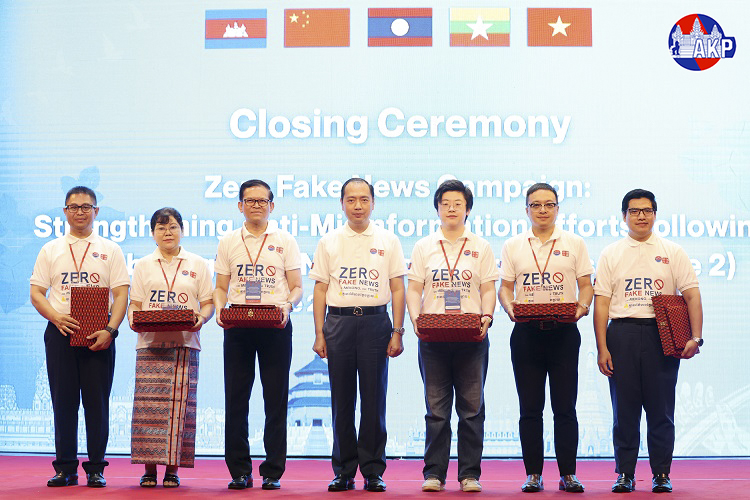
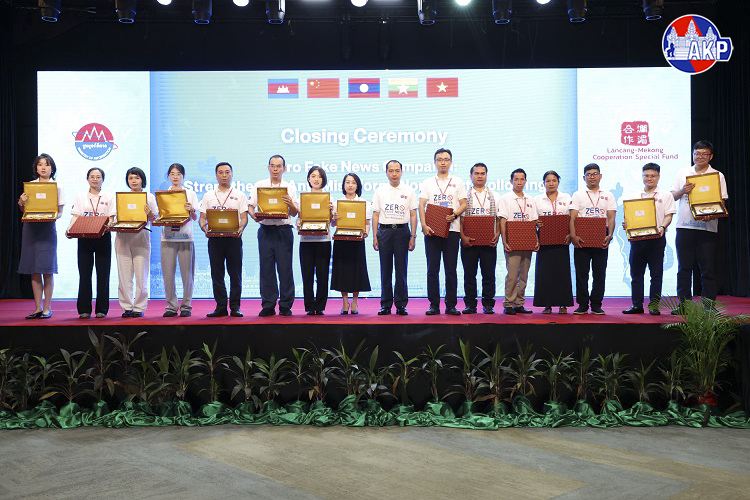
Speaking at the closing ceremony of the Zero Fake News Campaign: Strengthening Anti-Misinformation Efforts Following Combating Fake News for Journalists (Phase 2) held on June 2 in Phnom Penh under the theme “Building Regional Trust, Digital Resilience, and Responsible Information Sharing,” the Minister emphasised that misinformation has evolved beyond a media concern into a strategic issue affecting public trust, social harmony, national resilience, digital security, regional confidence, and sustainable development.
“Fake news is no longer only a media issue. It is a strategic issue that impacts public trust, social stability, and cooperation among nations,” he said.
H.E. Neth Pheaktra noted that in the digital era, false information can spread rapidly across borders, languages, platforms, and communities within minutes. Such misinformation can mislead citizens, generate fear, weaken confidence in public institutions, disrupt social cohesion, and undermine regional cooperation.
He stressed that information integrity forms the foundation of public trust, while public trust supports peace and social order – both of which are essential for sustainable development at the national, regional, and global levels.
“The fight against fake news is not only about correcting false information. It is about protecting peace, preserving social order, strengthening mutual understanding, safeguarding social stability, and ensuring that our societies can move forward with confidence and resilience,” he said.
Addressing the growing challenges posed by emerging technologies, H.E. Neth Pheaktra warned that countries in the Mekong-Lancang region must prepare for a new generation of misinformation driven by artificial intelligence, deepfakes, synthetic media, fake accounts, manipulated images, and coordinated disinformation campaigns.
He called on governments to invest in digital verification tools, AI literacy, technical capacity building, and regional knowledge-sharing initiatives to strengthen defences against increasingly sophisticated forms of online deception.
At the regional level, H.E. Minister highlighted the potential role of the Mekong-Lancang Cooperation (MLC) framework in strengthening efforts to combat misinformation. Beyond serving as a platform for development cooperation, he said, the MLC could become a practical mechanism for promoting information integrity, digital resilience, and responsible communication among member countries.
To advance this goal, H.E. Neth Pheaktra proposed several initiatives, including the establishment of a Mekong-Lancang Information Integrity Network to facilitate regular information sharing among government agencies, media organisations, fact-checkers, academic institutions, civil society groups, youth networks, and technology partners.
He also recommended the creation of a regional fact-checking and rapid response mechanism that would enable member countries to verify information more efficiently, coordinate responses to false narratives, and disseminate accurate information during crises, emergencies, natural disasters, public health events, and other sensitive situations.
In addition, he called for joint public awareness campaigns promoting responsible online behaviour through messages such as “Verify Before You Share,” “Check the Source,” “Think Before You Click,” and “Say No to Fake News.”
The Minister further advocated for expanded media and digital literacy programmes targeting schools, universities, rural and border communities, youth groups, women, local leaders, and vulnerable populations. He underlined that educational materials should be practical and adaptable to national and local languages to ensure broad accessibility.
Recognising the important role of media professionals and digital content creators, H.E. Neth Pheaktra also proposed regular capacity-building programmes focusing on fact-checking, source verification, crisis communication, ethical journalism, AI-generated misinformation, deepfake detection, platform literacy, and responsible digital engagement.
He encouraged stronger cooperation among governments, media institutions, technology companies, and digital platforms to improve misinformation detection, verification, correction, public education, and accountability while respecting the national circumstances of each country.
H.E. Minister also urged universities, journalism schools, think tanks, and media organisations to conduct research on misinformation trends, public trust, digital behaviour, and effective counter-disinformation strategies across the Mekong-Lancang region.
Among other recommendations, he proposed pilot projects and follow-up activities such as school outreach programmes, youth ambassador initiatives, media competitions, regional workshops, joint fact-checking exercises, public service announcements, digital campaigns, and annual forums dedicated to information integrity.
Concluding his remarks, H.E. Neth Pheaktra called for the adoption of a shared regional principle of responsible information sharing, founded on truth, mutual respect, constructive dialogue, cultural understanding, and the responsible use of digital technologies.
“A trusted Mekong-Lancang information space must be built on cooperation, not confrontation; on facts, not rumors; and on responsibility, not manipulation,” he said.
By Heng Panha