 KH
KH  FR
FR  AR
AR CN
CNCambodian Senate Backs Government’s Move to Resolve Maritime Claims through UNCLOS Conciliation
AKP Phnom Penh, June 02, 2026 –-
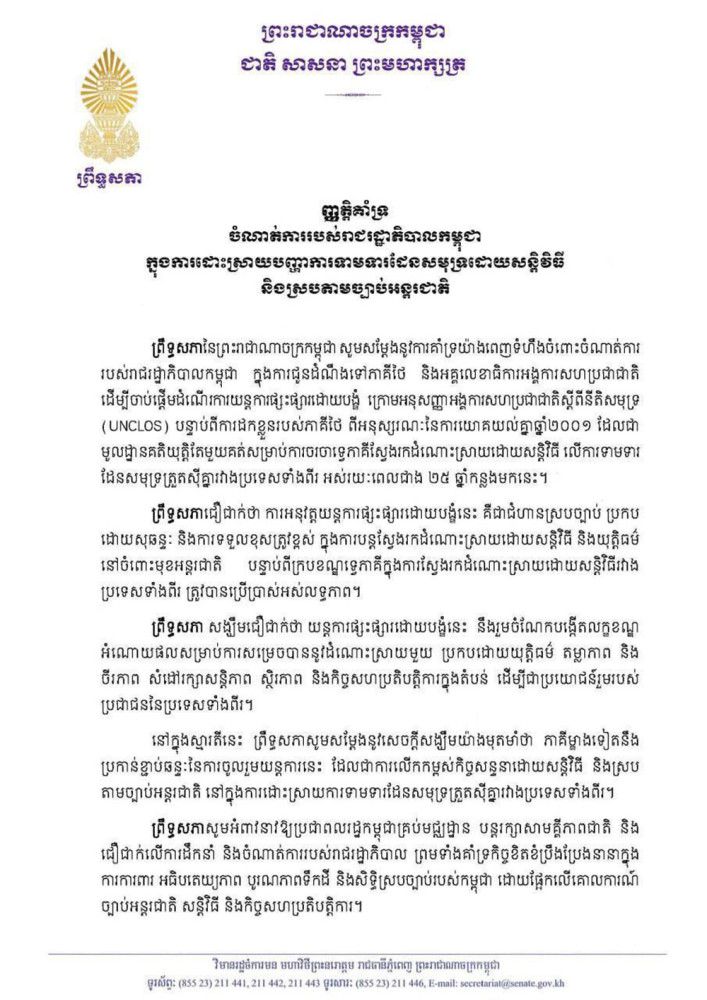
The Senate of the Kingdom of Cambodia has expressed its full support for the Royal Government’s decision to initiate compulsory conciliation proceedings under the United Nations Convention on the Law of the Sea (UNCLOS) to address overlapping maritime claims with Thailand.
In a motion adopted on Tuesday, the Senate endorsed the government’s action in notifying both the Thai side and the Secretary-General of the United Nations of Cambodia’s decision to begin the compulsory conciliation process. The move follows Thailand’s withdrawal from the 2001 Memorandum of Understanding (MoU), which had served as the sole legal framework for bilateral negotiations on the overlapping maritime claims for more than 25 years.
The Senate described the recourse to UNCLOS compulsory conciliation as a lawful step undertaken in good faith and with a high sense of responsibility, aimed at seeking a peaceful and equitable solution through international legal mechanisms after bilateral efforts had been fully exhausted.
According to the motion, the Senate believes the conciliation process will help create favourable conditions for achieving a fair, transparent, and sustainable settlement while preserving peace, stability, and regional cooperation for the mutual benefit of the peoples of both countries.
The Senate also expressed hope that the other party would participate in the process in a spirit of goodwill, thereby promoting peaceful dialogue and adherence to international law in resolving the maritime dispute.
At the same time, the Senate called on all Cambodian citizens to uphold national unity, maintain confidence in the leadership and actions of the Royal Government, and support efforts to safeguard Cambodia’s sovereignty, territorial integrity, and legitimate rights in accordance with international law, the peaceful settlement of disputes, and international cooperation.
The motion reaffirmed that respect for the rule of law, the promotion of good-neighbourly relations, and the peaceful resolution of disputes in accordance with international law remain the most effective means of ensuring lasting peace, stability, and sustainable prosperity in the region.

By C. Nika