 KH
KH  FR
FR  AR
AR CN
CNIMF: ‘The Outlook for Asia and the Pacific has Dimmed’
AKP Phnom Penh, April 25, 2025 --
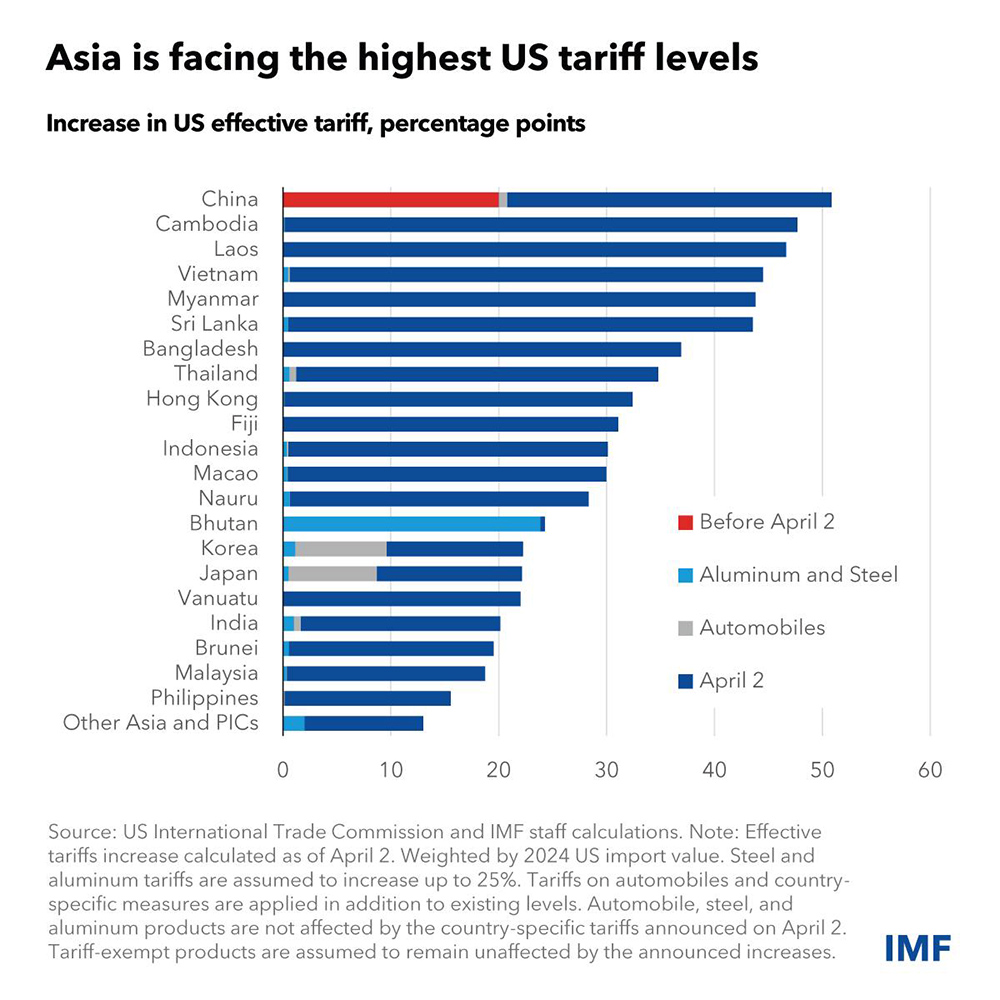
Surging trade tensions triggered by America’s announcement of punitive tariffs against most of its trading partners this month are an opportunity for Asia-Pacific economies to improve their resilience, the International Monetary Fund (IMF) says.
According to a commentary released by the fund’s Asia-Pacific Department in Washington Thursday, the region accounted for almost 60 percent of global growth last year.
TENSIONS, UNCERTAINTY HAVE ‘ESCALATED SIGNIFICANTLY’
But “the region’s successful growth model, based on trade liberalisation and integration into value chains, faces mounting challenges,” it says. ‘The outlook for Asia and the Pacific has dimmed.”
“While some levies have been paused, tensions between the United States and China have escalated significantly, as has trade policy uncertainty in general.”
The IMF is projecting regional growth to slow from 4.6 percent last year to 3.9 percent this year — down half a percentage point from its forecast in October.
The downgrade, its sharpest since the Covid pandemic, “reflects weaker global demand, reduced trade, tighter financial conditions, and heightened uncertainty.”
Growth next year is forecast to stabilise at 4 percent, albeit 0.3 points down from the October projection.
For emerging market and developing economies in the region (excluding the advanced economies of Australia, Hong Kong, Japan, Korea, Macao, New Zealand and Singapore), the IMF now expects growth of 4.5 percent, a downward revision of 0.5 points.
“Tariffs will weigh on the global economy and dent the region’s post-pandemic economic momentum. That’s because exports have led growth in many emerging economies amid lackluster domestic demand,” the IMF warns.
Moreover, Asia’s robust high-tech exports to America and other advanced economies are “leaving many Asian economies more vulnerable to fluctuating U.S. demand and rising protectionism.”
DIVERSIFYING EXPORTS, NEW TRADE AGREEMENTS
Despite growing trade tensions, tighter financial market conditions and increased uncertainty, the IMF sees an upside.
“New trade opportunities, through diversification of export markets and new trade agreements, and renewed structural reform momentum could lift growth,” it says.
“Heightened trade tensions call for a more balanced growth model, led by stronger and structurally durable domestic demand in some countries, and greater diversification of exports and stronger regional economic ties more broadly.”
Export diversification and regional integration “could help insulate economies from global shocks.”
BIG SCOPE FOR ASEAN AND RCEP IN MULTIPLE AREAS
“We see significant scope for more intra-regional trade in ASEAN, based on greater integration in the trade and financial spheres.
“In a similar vein, initiatives like the Regional Comprehensive Economic Partnership can help deepen cooperation — not only in the trade of goods, but also in services, the digital economy, and regulatory harmonisation.
“Success in these areas increasingly hinges on digital capabilities, an area where Asia is making significant strides.”
STRUCTURAL REFORMS ESSENTIAL
The IMF says policies should be “flexibly calibrated and tailored to individual country circumstances.”
Given the huge shock to external demand, “fiscal policy must also cushion the near-term impact.”
At the same time, “risks to financial stability from disorderly market movements should be managed carefully.”
The IMF notes that productivity growth in Asia has slowed over the past decade — particularly in emerging economies.
“Structural reforms will be essential for long-term resilience,” it says. “Adopting artificial intelligence and other advanced technologies could help reverse this if supported by investments in skills, infrastructure, and regulatory frameworks.
“Digitalisation, which is already advanced in many parts of Asia, can help increase productivity and generate new jobs, particularly in services.”
‘THE WORLD HAS CHANGED’
The authors recall that Asia’s export-led growth model has delivered unprecedented prosperity.
“But the world has changed. Trade is more uncertain, government budgets more constrained, and domestic demand more important than ever.
“Policymakers must act decisively,” the commentary concludes.
“The challenges are real. So are the opportunities. Embracing smart policy choices will help Asia write the next chapter of its growth story — not just as the world’s factory, but as a dynamic, resilient, and integrated economic power.”
By Sao Da